






When a parent or spouse is diagnosed with dementia, one of the first practical questions families ask is whether a medical alert system still makes sense. It is a fair question, and it deserves a more honest answer than a sales page usually gives.
The short version: yes, often, and especially in the earlier stages. But the way a system helps changes as dementia progresses, and knowing that up front is what makes the difference between a device that quietly does its job and one that sits in a drawer.
Quick Answer
Medical alert systems can support people living with early to middle stage dementia, particularly systems with automatic fall detection and GPS location. They work best as one layer in a broader safety plan alongside routines, home adjustments, and family support, and the right fit changes as dementia progresses.
Can someone with dementia use a medical alert system?
In the early and middle stages of dementia, many people can and do. Pressing a single button is a simple, well practiced action, and for someone who has worn the button for months it often stays familiar long after newer routines fade. Habits learned early tend to hold.
That is also the honest limitation. A traditional help button relies on the person remembering to wear it and remembering to press it. As dementia progresses, both of those become less certain. This is why the most useful features for families navigating dementia are the ones that do not depend on memory at all.
The two features that do not rely on memory
Automatic fall detection
Falls and dementia travel together. Changes in balance, depth perception, and judgment all raise fall risk, and a person in the middle stages may not think to press a button after a fall, or may not be able to.
Fall detection is designed for exactly that gap. If the system detects a fall, it can place the call automatically, without the person needing to remember anything at all. No fall detection technology detects 100 percent of falls, so the button should still be pressed whenever help is needed, but for a family managing dementia, automatic detection turns the device from something your loved one operates into something that also watches out for them.
GPS location
According to the Alzheimer’s Association, about 6 in 10 people living with dementia will wander at least once, and many will do so more than once. It is one of the most frightening moments a family can face, and it is also one where minutes matter.
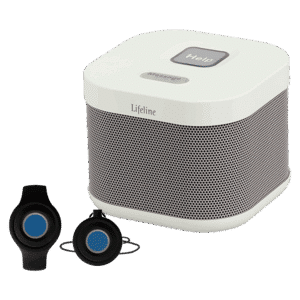
A mobile system like Lifeline On the Go uses GPS, so when the button is pressed or fall detection activates, the response center can identify your loved one’s location and send help there, not just to the home address on file. The Alzheimer’s Association notes that location technology should be used alongside other safety measures, not in place of them, and that is exactly the right way to think about it: one strong layer in a larger plan.
How the fit changes by stage
No two people move through dementia the same way, so treat these as patterns rather than rules, and talk them through with your loved one’s doctor.
Early stage
A help button works much the way it does for anyone else. This is the best time to introduce one, because the habit of wearing it and using it is built while learning is still easy. Many people in the early stages describe the button as a way of staying independent, not giving independence up.
Middle stage
The button may still be used, but fall detection and GPS start doing more of the work. Caregiver notifications through the response center keep family in the loop. Wandering risk typically rises in this window, which makes an on the go system with location support worth serious consideration.
Later stages
A medical alert system is not a substitute for supervision or hands on care, and it would be wrong to suggest otherwise. In the later stages it can remain a useful layer for the hours a caregiver is in another room, but the safety plan at this point is built around people, not devices.
Introducing the system without a fight
Families often worry more about the conversation than the device. A few things consistently help.
- Start early. A button introduced in the early stages becomes routine. A button introduced during a crisis becomes a symbol of the crisis.
- Frame it as independence. “This is how you stay in your own home” lands very differently than “this is because we are worried about you.” Both are true. Lead with the one that feels like respect.
- Make wearing it automatic. Tie it to an existing habit, such as putting it on with glasses or a watch in the morning. Waterproof pendants can stay on in the shower, which is where many falls happen and where removing the button is the quiet failure point.
- Practice together, without pressure. A calm demonstration press, arranged with the response center, lets your loved one hear a friendly voice answer. That single experience does more than any explanation.
What a medical alert system is not
It is worth being plain about this, because families deserve accuracy more than reassurance.
A medical alert system is not supervision. It is not a caregiver, and it does not replace one. It is not continuous surveillance, and for many people that is precisely its dignity: it is a way to ask for help on your own terms, and a way for help to arrive fast when it is needed.
If you are weighing in home care, adult day programs, or memory care alongside a device, those are conversations for your loved one’s care team, and organizations like the Alzheimer’s Association offer support lines and local resources for families working through them. We wrote about where families find that support, and about practical distraction techniques for difficult moments, as part of this same series.
When to talk with a doctor
Bring the doctor in early, and not only for the diagnosis itself. A sudden increase in confusion, new wandering behavior, or a change in balance or gait can each have treatable causes, and each also changes what the right safety plan looks like. If you are unsure whether a change is urgent, that is a reasonable question for a medical professional, and it is a better question to ask a week too early than a day too late.
A dementia diagnosis changes a great deal, but it does not change the goal most families share: keeping the person they love safe, comfortable, and themselves for as long as possible. A medical alert system will not carry that goal on its own. Used honestly, as one layer among several, it carries more of it than most families expect.
If you would like help thinking through which system fits your family’s situation, our team is available at 855-415-5755.
Peace of Mind That Lets You Step Away
For many caregivers, the hardest part of self-care is the worry that comes with stepping away. What if something happens during the hour you are gone?
That is where Lifeline can help. With HomeSafe, your loved one is connected to a caring, trained response team 24/7 at home. With On the Go, that same connection travels with them wherever they go. Optional fall detection is designed to automatically signal for help if a fall is detected, even if they cannot press their button.*
Not sure which system fits your family? Our product quiz can help, or call us to talk it through with a real person.
*Fall detection does not detect 100% of falls. If able, users should always press their button when they need help.
That is what Lifeline has always been about. Not just for the person wearing it, but for everyone who loves them.
Frequently Asked Questions
Can a person with dementia use a medical alert button?
Often, yes, especially in the early and middle stages when pressing a familiar button remains a well practiced action. Introducing the button early helps the habit hold as dementia progresses. Features that do not rely on memory, such as automatic fall detection, become more important over time.
Is a medical alert system with GPS good for someone who wanders?
It can be a strong layer of protection. About 6 in 10 people living with dementia will wander at least once, and a GPS enabled system allows the response center to identify the person’s location when the button is pressed or a fall is detected. It should be used alongside other safety measures, not instead of them.
Does fall detection work for people with dementia?
Automatic fall detection is particularly relevant for dementia because it does not depend on the person remembering to press their button. If the system detects a fall, it can place the call automatically. No fall detection technology detects 100 percent of falls, so the button should still be pressed whenever help is needed.
When should a family stop relying on a medical alert system?
A medical alert system is one layer of a safety plan, not a substitute for supervision. In the later stages of dementia, care decisions center on people rather than devices, and the system becomes a supporting layer for the hours a caregiver is nearby but not in the room. Discuss the right balance with the care team.
How do I get a parent with dementia to wear a medical alert button?
Start early, frame the button as a way to stay independent at home, and tie wearing it to an existing daily habit such as putting on glasses. A calm practice press arranged with the response center, so your loved one hears a friendly voice answer, often does more than any explanation.